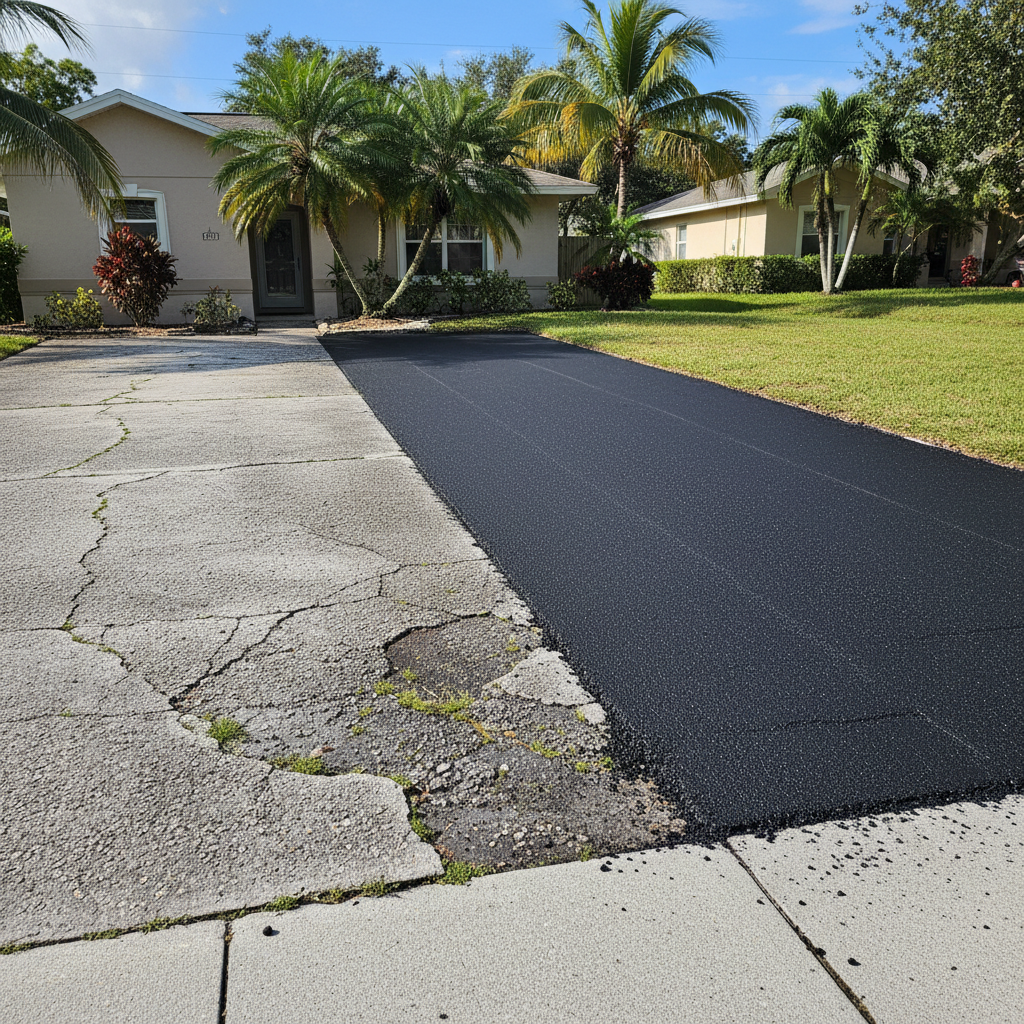
Alright, let's talk about asphalt milling. If you've got an old, beat-up driveway or parking area that's seen better days, you've probably heard the term 'milling' thrown around. It's basically how we get rid of the old stuff to make way for the new. But there are a couple of main ways to go about it, and picking the right one for your New Port Richey property can save you a headache — and some cash — down the road.
I'm talking about the difference between a 'mill and fill' (often called partial-depth milling) and a 'full-depth removal and replacement.' Both get you a new surface, sure, but they're pretty different in terms of what's underneath and what you can actually expect.
What's a Mill and Fill?
A mill and fill is exactly what it sounds like. We bring in a milling machine, which is essentially a giant planer, and it grinds off the top layer of your existing asphalt. We're usually talking about taking off anywhere from 2 to 4 inches. Once that old, cracked, or rutted surface is gone, we clean up the base, maybe do some minor repairs to the sub-base if it needs it, and then lay down new asphalt. It's kind of like giving your driveway a fresh skin.
Pros of Mill and Fill:
- Cost-Effective: This is usually the big one. Since we're not digging down to the dirt, there's less material to haul away and less new material to bring in. That means lower labor and material costs for you.
- Faster Project Time: Less digging and less sub-base work means we can get in and out quicker. You'll have your new surface ready to go in less time.
- Less Disruptive: Because we're not tearing everything up, there's less mess and less impact on your landscaping or surrounding areas.
- Recycling: The milled material (called 'RAP' for Reclaimed Asphalt Pavement) can often be recycled. That's good for the environment, right?
Cons of Mill and Fill:
- Depends on the Base: This is crucial. A mill and fill only works well if your underlying base (that's the dirt and rock layer beneath the asphalt) is still in good shape. If that base is failing – soft, unstable, or has drainage issues – then just putting a new top layer on it is like putting a band-aid on a broken leg. You'll see problems again, probably sooner than later.
- Limited Structural Improvement: While it gives you a smooth new surface, it doesn't really make the overall pavement stronger if the deeper layers are already compromised.
What's Full-Depth Removal and Replacement?
This is the full enchilada. With full-depth removal, we're not just taking off a few inches; we're excavating everything down to the subgrade. That means all the old asphalt, and often some of the base material, gets dug out and hauled away. Then, we re-establish a proper sub-base, compact it thoroughly, lay down new aggregate base material, compact that, and finally, pave with brand new asphalt layers.
Pros of Full-Depth Removal:
- Long-Term Durability: When done right, this gives you a brand new, structurally sound pavement from the ground up. You're building a fresh foundation, which means it's going to last a lot longer, especially with our heavy rains and sandy soil here in New Port Richey.
- Addresses Underlying Issues: If you've got serious drainage problems, soft spots, or a completely failed base, this is the only way to truly fix it. We can re-grade, install new drainage, and build a strong foundation.
- Complete Control: We have total control over the quality of every layer, making sure compaction and material consistency are just right.
Cons of Full-Depth Removal:
- Higher Cost: More digging, more hauling, more new base material, and more labor – it all adds up. This is definitely the more expensive option upfront.
- Longer Project Time: It takes more time to dig everything out, prepare the subgrade, lay new base, and then pave.
- More Disruptive: Expect more noise, dust, and general disruption to your property while the work is being done.
Which One Should You Choose?
This isn't a one-size-fits-all answer, but I can tell you what I've seen work best around here. If your driveway or parking lot has widespread alligator cracking, potholes that keep coming back, or areas that consistently sink, that's a pretty strong sign that your base is failing. In those cases, a mill and fill is just kicking the can down the road. You'll spend money now only to spend more money again in a few years.
For properties where the asphalt is just old, faded, has some minor surface cracks, or maybe some shallow rutting but the overall structure feels solid, a mill and fill can be a fantastic, cost-effective solution. It'll give you a beautiful, smooth new surface that will last for years, assuming that good base is underneath.
My recommendation for most homeowners in New Port Richey, especially if your pavement is showing signs of serious fatigue – like those deep, interconnected cracks or areas that hold water – is to go with full-depth removal and replacement. Yes, it's more expensive initially, but it's an investment in a pavement that will stand up to our Florida sun, heavy rain, and the constant traffic for decades. You won't be dealing with repairs every few years, and you'll have confidence knowing it's done right from the ground up.
When we come out for an estimate at Pioneer Asphalt Co, we'll always assess the condition of your existing pavement and the underlying base. We'll tell you straight up what we think is the best long-term solution for your specific situation, not just the cheapest or fastest fix. It's about getting you the best value and the longest-lasting results.